I once walked into a listing meeting for an expensive home as a single agent, up against teams. I lost. The teams came in with folders full of printed material. I'm confident that if I'd walked in with a website for the home, social posts and a full plan for marketing it, I would have won.
That meeting taught me how to get real estate leads that actually turn into listings. Getting the conversation is half the job. The other half is what you show the seller once you have it. Below are 11 lead sources, ranked roughly by how fast they get you to a listing appointment, with scripts and a weekly schedule you can run.
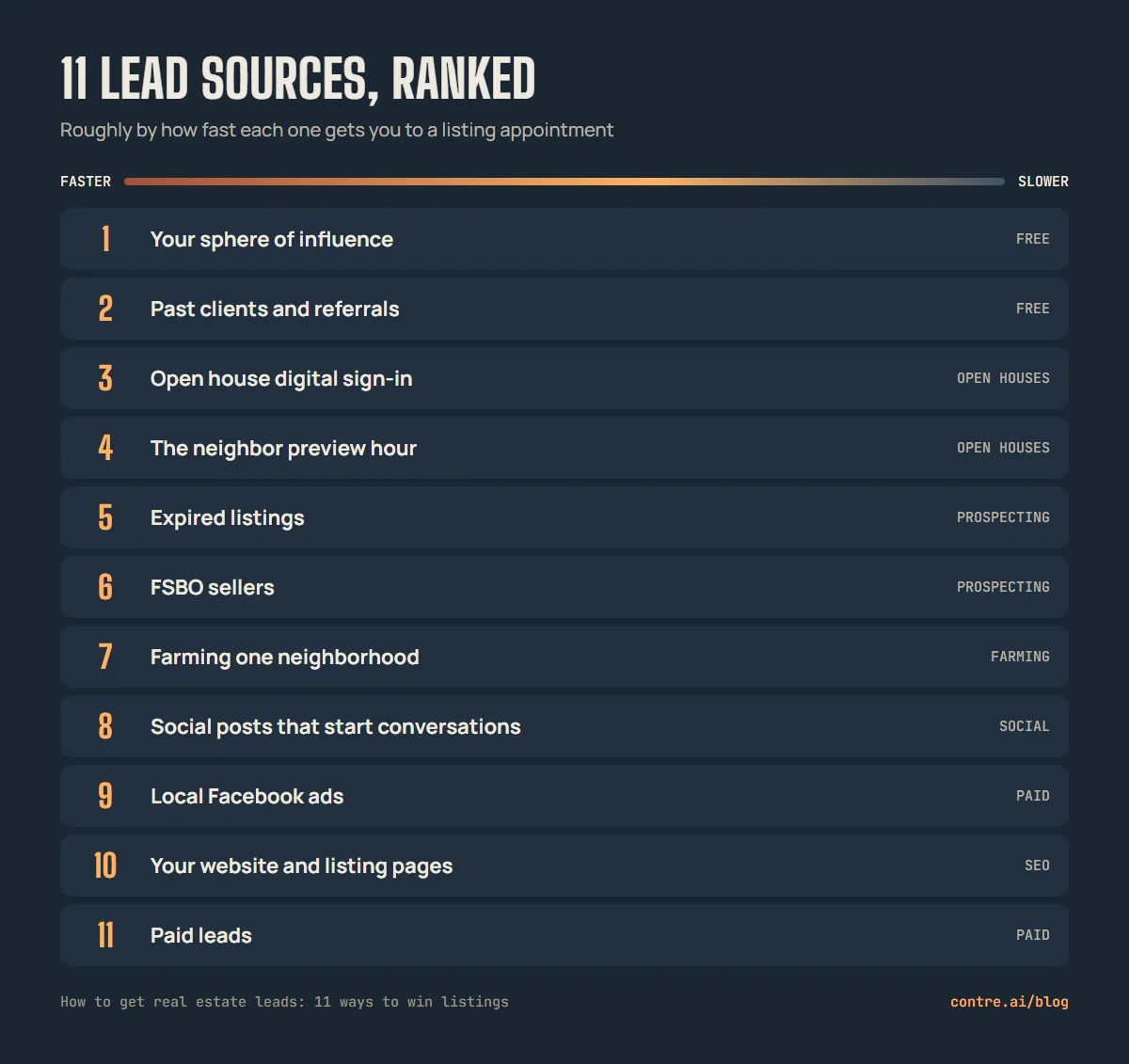
Quick answer: The fastest ways to get real estate leads are your sphere and past clients, open houses with digital sign-in, expired and FSBO listings, and farming one neighborhood. Paid leads work but cost more per closing. What turns a lead into a listing is a same-day reply and showing the seller a real marketing plan.
Where sellers actually find their agent
In the NAR 2025 Profile of Home Buyers and Sellers, 66% of sellers hired an agent who was referred to them or one they had worked with before. That breaks down to 37% referred by a friend, neighbor or relative, and 29% who went back to an agent they'd used. Just 3% met their agent at an open house (NAR 2025 Profile, Exhibit 7-2).
The other number to remember: 80% of sellers contacted only one agent before they signed (Exhibit 7-3).
So the seller usually isn't comparing you to anyone. They call the person they already know, or the person a friend names. Your lead generation has one job: be that name.
Free real estate leads from people who already know you
Two-thirds of sellers hire someone they already know or someone a friend recommends. That makes this the cheapest lead source you have. It costs nothing but time.
1. Your sphere of influence
Write down 50 people who would take your call: friends, past coworkers, your kids' coaches, your dentist. Then plan three touches over 90 days:
- Touch 1, a call: "I'm putting together home values for a few people this month. Want me to include yours?"
- Touch 2, something useful: a short note on what sold near them and for how much.
- Touch 3, the ask: "If anyone you know mentions selling this year, I'd be glad to put together their marketing plan before they decide anything."
A home value is the easiest opener in real estate. Nobody says no to knowing what their house is worth.
2. Past clients and referrals
Past clients already trust you. The risk is that they forget your name by the time they sell, often years later.
Send them their home's value twice a year, with your name on it. It gives you a reason to reach out that isn't a sales pitch, and it puts you in front of them right when they start thinking about a move. If you want a longer playbook on this, read how to strengthen every client relationship.
A free listing description tool gives you a polished draft in a minute for new listings and past-client updates.
Open houses that bring in seller leads
3. Digital sign-in at the door
Put a QR code on the sign by the front door. Visitors scan it and sign in on their phone, so you leave with names, numbers and permission to text instead of a sheet of half-readable emails.
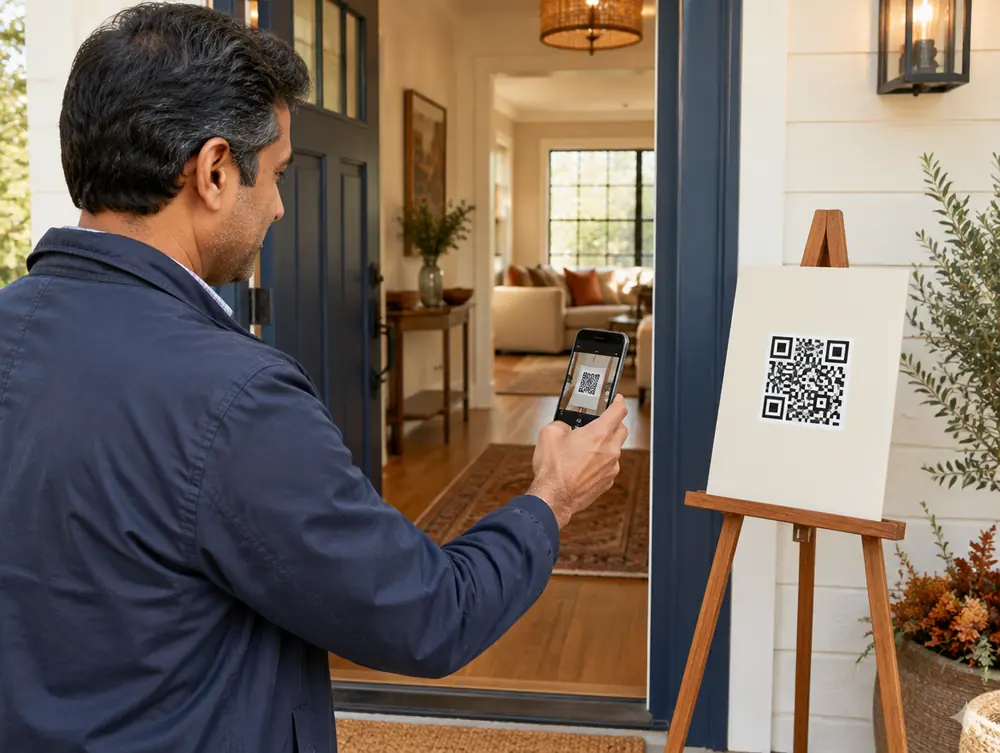
Text every visitor within 24 hours: "Thanks for stopping by 17 Birch Way. Here's the link with photos and the price. Are you looking to buy this year, or just seeing what's out there?"
The second half of that question finds the sellers. Some open house visitors own a home nearby.
Keep it fair housing compliant. Ask about timeline, financing and whether they're working with an agent. Never ask about family, religion, national origin, disability or anything else covered by the Fair Housing Act. Get clear consent before you text.
4. The neighbor preview hour
Invite the street 30 minutes before the open house starts. Drop a short note in each door a few days ahead. Neighbors are curious what the house will sell for, and some of them are next year's sellers.
Expired and FSBO listings (real estate prospecting)
5. Expired listings
An expired listing is a seller who still wants to sell. They just haven't sold yet. That makes them some of the warmest leads you can call.
Before you dial, check the National Do Not Call Registry and your state's rules on calling hours.
A simple phone script:
"Hi, this is [name] with [brokerage]. I saw your home at [address] came off the market. Are you still planning to sell? ... I'd like to show you a fresh marketing plan for your home before you decide anything: a website for the property, social posts and a pricing review. Could I send it over this week?"
Keep it about the new plan. Don't comment on the last agent, the photos or the old description. The seller chose that agent, and knocking their choice loses the room fast.
If they don't answer, mail a one-page letter with the same offer and a QR code to a sample property website.
6. FSBO sellers
For-sale-by-owner sellers are a small group now. NAR reports FSBO sales hit an all-time low of 5% in 2025. They still pick up the phone.
Lead with help, not a pitch: "Want a checklist of the documents buyers' agents will ask you for?" Answer their questions. When the paperwork piles up, you're the agent who already helped.
Farm one neighborhood
7. Pick a farm and show up every month
Farming means owning one area so well that you're the name people think of when they decide to sell.
Pick your farm by turnover. Count the sales in the last 12 months and divide by the total number of homes. A higher rate means more chances each year. Choose a price range you know and enough homes to matter, a few hundred at least.
Then show up every month:
- Week 1: a just-sold postcard for any home that closed nearby.
- Week 2: a short market update: median price, days on market, what's under contract.
- Week 3: a door-knock day on one street, with the market update in hand.
Consistency matters more than design. Most farms take months before the first call comes in, so commit before you start.
Social media and video that start conversations
8. Posts that get messages, not just likes
Three post types tend to start real conversations:
- The just-listed tour: a 30-second walk-through reel of a new listing.
- The neighborhood price change: "Homes on the east side sold for [X]% more this spring. Here's why."
- What your money buys: "What $500,000 buys in three nearby towns."
Post three times a week and one reel. End each with one clear next step, like "Message me for the full list."
9. Facebook ads for realtors
A small local ad can work for seller leads if it offers something specific. A "What's my home worth?" or "Seller's guide to [town]" ad pointed at a short form is a common setup. Budgets vary widely by market. Start small, track cost per conversation, and stop what doesn't produce appointments. For a benchmark, WordStream's 2026 Facebook ads benchmarks put the average real estate cost per lead at $13.74.
Your website and local SEO
10. Give every listing a strong online presence
Buyers start online. In the NAR 2025 Profile of Home Buyers and Sellers, 52% of buyers found the home they bought on the internet, and 46% said their first step was looking at homes online. Only 27% found their home through an agent.
So the listing itself is your best ad, both for the buyer searching tonight and for the neighbor who looks up the address next spring. Sellers know this. When you show them how their home will look online, you're answering the question they care about most: will buyers find it?
Here's what a strong online presence looks like for each listing:
- A page for the home. A property website with the photos, the price, the details and a way to ask questions. In NAR's survey, buyers who searched online rated photos (81%) and detailed property information (77%) as the most useful website features.
- Words people search. Use the street, the neighborhood and the features buyers type in, like "single-story home near [school]," in the description and page title.
- Your Google Business Profile. Add your service area, photos of your listings and reviews from past clients, so your name shows up next to the homes.
- Posts that point back to the page. Every reel and social post should link to the listing page, not just the portal.
The page keeps working after the sale. The neighbor who searched the address, the buyer who missed out and the owner down the street are all future leads, and your name is on it. You can build this package before you even have the listing, so the seller sees it on day one.
Paid real estate leads: what they cost and when they pay
11. Buy leads, with the math done first
Paid leads come in two models.
Pay per lead. You pay for each contact whether it closes or not. Zillow says its Premier Agent program averages $223 per connection in major metro areas and $139 elsewhere. Realtor.com doesn't publish a rate card for Connections Plus. You buy a share of the leads in a ZIP code for six or 12 months, and the price is quoted by market.
Pay at closing. No upfront cost. The company takes a referral fee from your commission when the deal closes. Zillow's pay-at-closing program, Zillow Preferred, charges 15% to 40% of your commission depending on market and price, and 40% on every seller connection.
Do this math before you buy:
Cost per closing = cost per lead ÷ your close rate.
For example, at $223 a lead and a 3% close rate, each closing costs you about $7,433 in leads. At a 40% seller-connection fee on a $10,000 commission, a closing costs you $4,000. Run your own numbers with your own close rate. A new agent with a budget but no sphere can use paid leads to get started. Everyone else should treat them as a top-up, not the plan.
How to turn a lead into a listing appointment
Every channel above gets you a conversation. Here's what turns it into a signed listing.
Reply the same day. How fast you answer shows the seller how you'll handle their sale. Even a two-line text, "Got it, I'll send your home's value and a marketing plan by tonight," holds your place.
Show the plan before the meeting. Back to that listing I lost. The teams brought folders. I'm confident a website for the home, social posts and a full marketing plan would have beaten the folders. Most sellers have never even thought about seeing their marketing before they list. When you show it to them first, you're the agent who already did the work.
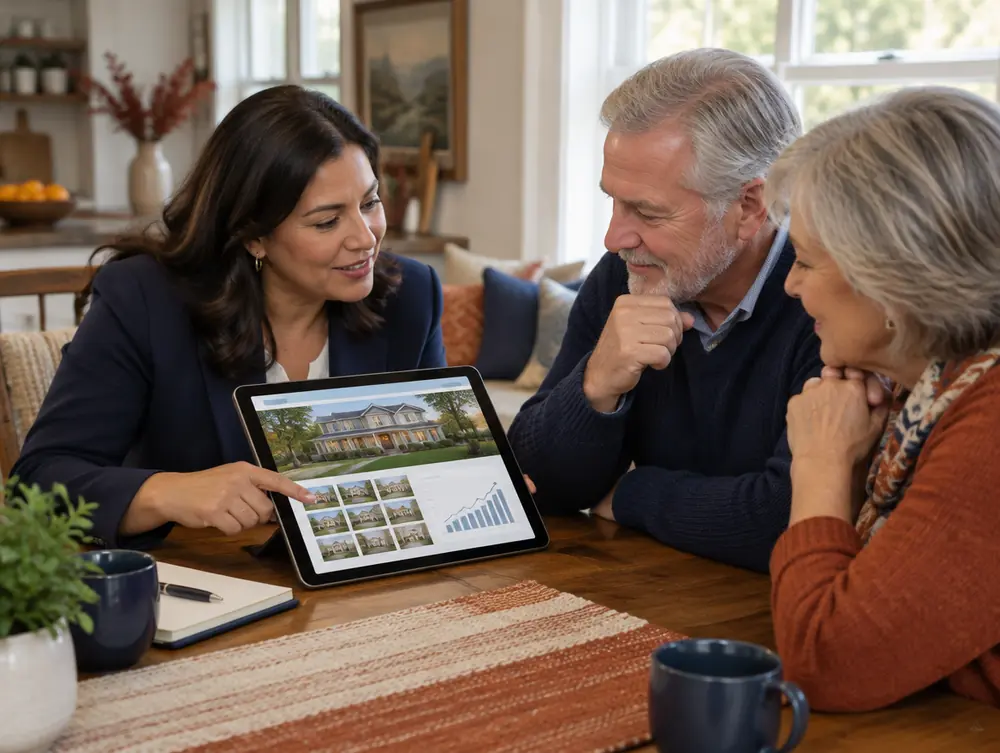
If you'd rather not build it by hand, tools like Contre can put together a private preview of a home's marketing: a property website, social posts and a home valuation. It stays private until the seller signs.
Bring a number. Sellers want to know what the home is worth. A valuation with nearby sales answers that before they ask.
Ask for the listing. "Here's the plan. If it looks right, I can have this live the day we sign."
A weekly lead generation schedule
Pick the channels that fit your market and put them on the calendar. Here's a week that covers most of them in about six to eight hours:
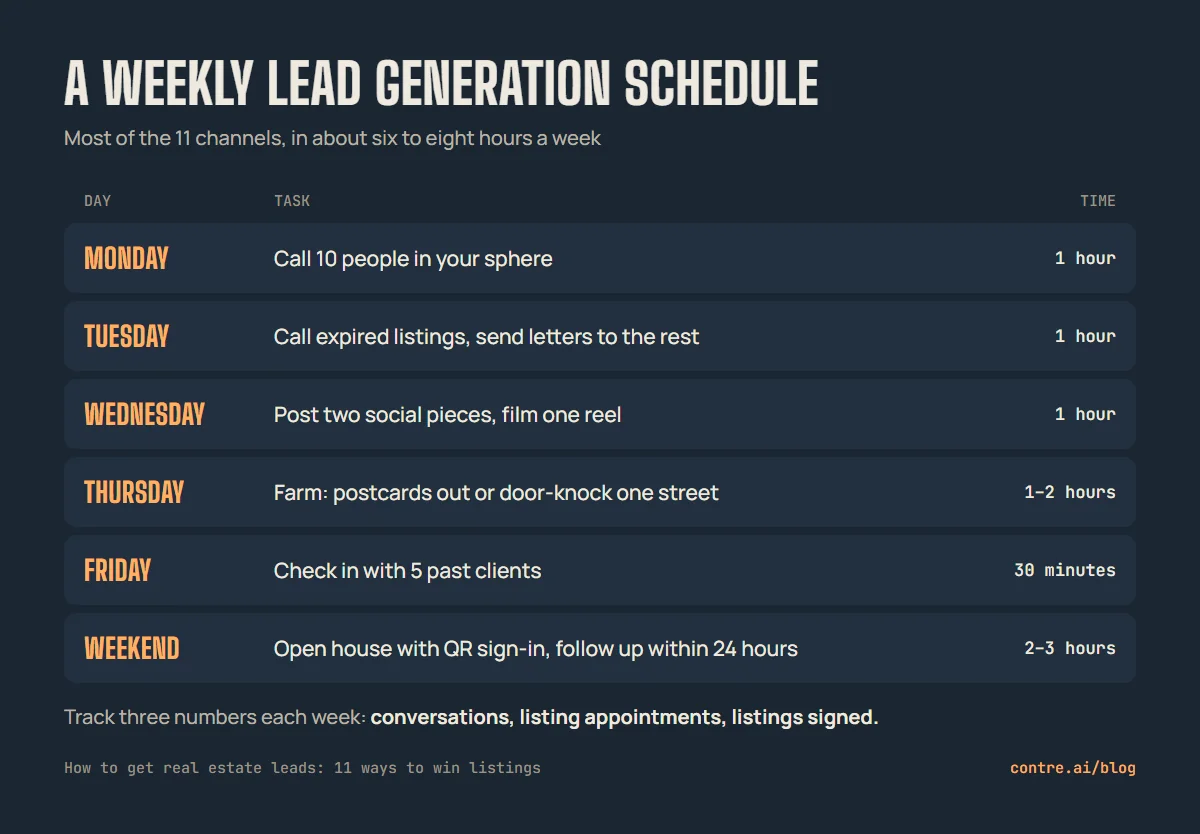
| Day | Task | Time |
|---|---|---|
| Monday | Call 10 people in your sphere | 1 hour |
| Tuesday | Call expired listings, send letters to the rest | 1 hour |
| Wednesday | Post two social pieces, film one reel | 1 hour |
| Thursday | Farm: postcards out or door-knock one street | 1–2 hours |
| Friday | Check in with 5 past clients | 30 minutes |
| Weekend | Hold an open house with QR sign-in, follow up within 24 hours | 2–3 hours |
Track three numbers each week: conversations, listing appointments and listings signed. Your conversion rate is listings signed divided by conversations. After a month you'll know which two channels pay best. Do more of those.
FAQ
How much do real estate leads cost?
It depends on the model. Zillow reports an average of $223 per connection in major metros and $139 elsewhere. Pay-at-closing programs charge nothing upfront and take a share of your commission at closing (Zillow Preferred charges 15% to 40%, and 40% on seller connections). Compare cost per closing, not cost per lead.
How do I get real estate leads for free?
Start with your sphere and past clients, since 66% of sellers hire someone referred to them or someone they've used before (NAR 2025). Add open houses with digital sign-in, expired listings and a listing page for every home you sell.
How do new agents get real estate leads?
Tell your sphere you're licensed and offer each person a home value. Hold open houses for other agents in your office. Call expired listings with a fresh marketing plan. Paid leads can fill gaps if you have a budget and track your close rate.
How do I get real estate buyer leads?
Open houses, listing pages and local content bring in buyers. Many buyers also own a home, so ask every buyer lead whether they need to sell first.
How do I turn a real estate lead into a listing?
Reply the same day, send a home value, and show the seller their marketing plan before the listing meeting. Then ask for the listing.
Pick two channels this week
Don't try all 11 at once. Pick the two that fit where you are: sphere and open houses if you're newer, farming and your website if you're settled. Put them on your calendar for this week.
When you win the listing, Contre can help you run the file from contract to close.
Your first home is free, listing or contract. Start to finish.
Type in an address and Contre builds the listing marketing, then carries the same home through to closing.
Get your first home free